Community Engagement Plan
1. Executive Summary
2. Strategic Context
3. Engagement Objectives
4. Place Profile
Overview of the neighbourhoods
Demographics
Housing
Existing community assets and networks
5. Stakeholder and Community Mapping
Key groups:
Priority Neighbourhoods
6. Engagement Approach and Methods
Principles of engagement:
Methods of engagement
Analysing and reporting on feedback
7. Communications Plan
8. Resources and Capacity
9. Monitoring and Evaluation
10. Data Protection and Ethics
1. Executive Summary
The Pride in Place Programme relies on the power of local people and partnerships, bringing together residents, the local MP, councils, businesses and community organisations to produce a clear vision for their area and utilise government funding for investment in regeneration.
To enable this funding is been made directly available to local "overlooked" and disadvantaged communities via Local Authorities (who have the role as the accountable body). Accordingly the government has awarded £19.6m for the Birchen Coppice Middle Support Output Area (MSOA) with spending over a 10 year period to be determined in collaboration with residents and a newly formed Neighbourhood Board.
The Neighbourhood Board is responsible for producing the 10 year vision for Birchen Coppice, supported by interventions which are set out in the four year Regeneration Plan, to achieve the strategic objectives of the programme.
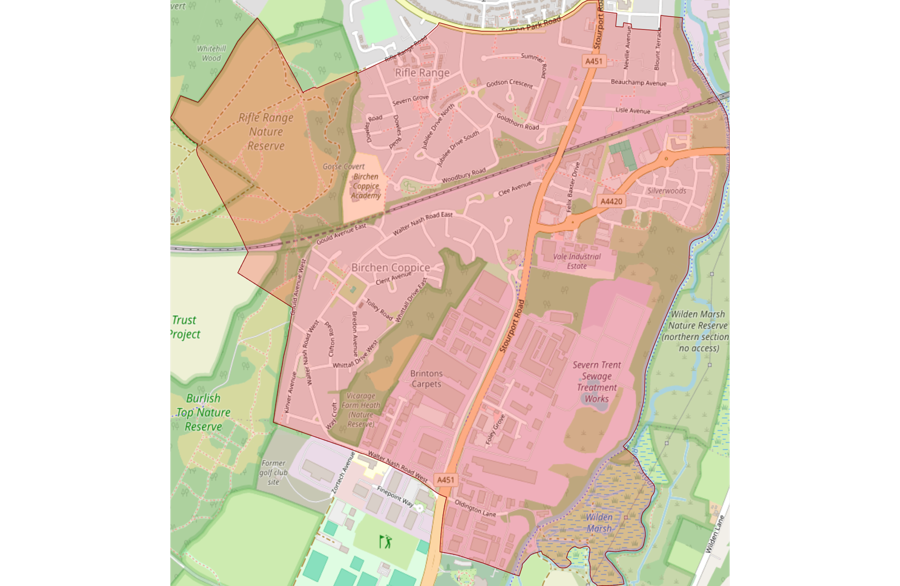
The Birchen Coppice MSOA covers the four lower support output areas (put in reference numbers) which include Birchen Coppice, the Rifle Range, Silverwoods and Foley Park. The map below shows the area covered including the proposed adjustment to the boundary to include all of Northumberland Avenue and Foley Park Primary School.
Underpinning the funding are three core objectives:
a. To build stronger communities – All places should have strong relationships and a collective sense of belonging to their community. This helps bring people together to build community cohesion and resilience, helping people to feel proud of their area and safe in their neighbourhood.
b. To create thriving places – Every part of the UK deserves to have vibrant neighbourhoods and communities with busy high streets and thoroughfares, a good range of local amenities and high-quality physical infrastructure.
c. To empower people to take back control – Everybody should be empowered and in control of their lives and have a say over the future of their community.
A guiding principle of the Pride in Place programme is that it is community led. The involvement of local residents who live and/or work in the Birchen Coppice MSOA to influence and determine how this funding is spent is critical and they can do this through community engagement with the Neighbourhood Board supported and assisted by the Council.
The Board, in agreement with the Council, will use a mixed methods approach to community engagement recognising that people want to participate on their own terms.
The Board leveraging on Council resources will combine online tools such as surveys with face to face sessions (including at existing groups or meetings), drop ins, community events, etc. to ensure maximum accessibility.
Where possible the Board will utilise and work with the Council and those organisations already based in the community to access harder to reach groups to build a comprehensive vision for the area.
2. Strategic Context
The Pride in Place programme identified Birchen Coppice MSOA on 5 February 2026 as one of the forty Phase Two areas for investment over the next ten years and has made £19.6m available (approximately 67% capital and 33% revenue) available to support local programmes identified and supported by the local community working through the Neighbourhood Board.
The Neighbourhood Board are responsible for working with the community to identify priorities for the areas and turning these into a vision for the area and a regeneration plan. They will then oversee the selection and delivery of Programmes that meet the vision and deliver on the priorities.
Underpinning the Pride in Place funding are three core objectives:
a. To build stronger communities – All places should have strong relationships and a collective sense of belonging to their community. This helps bring people together to build community cohesion and resilience, helping people to feel proud of their area and safe in their neighbourhood.
b. To create thriving places – Every part of the UK deserves to have vibrant neighbourhoods and communities with busy high streets, a good range of local amenities and high-quality physical infrastructure.
c. To empower people to take back control – Everybody should be empowered and in control of their lives and have a say over the future of their community.
The Government is aiming to move away from the complicated and time consuming approach of seeking approval from central government on all Programme elements and has identified a pre-prescribed list of Programmes) Pride in Place Programme: list of indicative interventions - GOV.UK) that could be considered for this funding.
Working with the local community builds on the asset-based community development (ABCD) approach Programme which ran in Birchen Coppice and other parts of the District between 2021-2025 and supports a wider range of strategies including the Health Action Plan 2026/27, Worcestershire Housing Strategy and Kidderminster 2040 vision. Economic growth and regeneration is one of three priorities in the Council’s Corporate Plan 2023 -2027 which the Board is aware of and will look to work with.
Through the Councils experiences of doing ABCD with the Community Builders the Council knows that recognising a communities strengths and supporting people within that community to identify any improvements is the way to achieve a lasting change. Community engagement is therefore critical to the delivery of this Programme so that the views, needs and aspirations of the community are captured and we work together to shape how the funding is utilised for the benefit of the Birchen Coppice MSOA.
3. Engagement Objectives
What the engagement is seeking to achieve
Community engagement is a central tenet of the Pride in Place Programme. How the funding is used must be driven by the communities within the Pride In Place geography (within the context of eligibility).
The Board will need to gain an understanding of people’s perceptions of place (recognising that the MHCLG/Zencity Benchmarking Survey Pulse Survey Results began to unpick this) and identify any priorities for investment. This information will inform the vision for the next ten years and the four year regeneration plan.
The Board will want to co-design solutions with residents but also have a transparent way for feeding back to them on ideas that can’t be progressed and this involves clear lines of communication, building trust and relationships and ensuring that communities feel they can directly influence decisions through the communication and engagement methods the Board uses.
This Plan will help outline the approach to engagement which will consider Arnstein’s Ladder of Citizens Participation (1969) as the benchmark for engagement. Ideally the plan will support the Board to engage in a way that enables citizen control to happen overtime.

4. Place Profile
Overview of the neighbourhoods
The area covered by the Programme fall into four neighbourhoods that make up the Middle Super Output Area. This MSOA is one of the most deprived neighbourhoods in England and further information regarding the indices of deprivation can be found here.
Demographics
The area has more 0-15 year olds than Worcestershire or England on average (20.5%) and a lower average of over 65+ than Worcestershire (18.6% as opposed to 23.4%).
96.6% describe themselves as white compared to 93.8% in Worcestershire and 81% in England.
42.8% have never been married or registered a civil partnership compared to 32.5% in Worcestershire and 37.9% in England.
29.3% of the residents have no qualifications compared to 18% in Worcestershire and 18.1% in England.
Housing
39.5% of housing is of social housing tenure, compared to 15.2% in Worcestershire and 17.1% in England. Correspondingly there are lower than average levels of private rented and home ownership than in Worcestershire or England.
Just under 50% of properties are in Council Tax Band A compared to 15% in Worcestershire and just under 25% in England.
Of the social housing owned by Community Housing Group (the largest social housing in the District) more than 50% are houses and just over 30% are flats.
Existing community assets and networks
The Community Builders Programme ran in the Birchen Coppice and Rifle Range part of the MSOA from 2021 – 2025 and worked with the community to map assets such as St Peters Community Church and community leaders. Many groups and activities have since been established and embedded including Breakfast Clubs, Foodshare and a community fridge, playgroups, exercise classes and a University of the Third Age class. In Silverwoods there is a well-established Residents of Silverwoods group. Adjacent to the Silverwoods housing estate is the Council’s Leisure Centre, an Aldi and a Public House in addition to number of food outlets and smaller shops dotted across the MSOA. There are two primary schools within the area and a family hub. Whilst there is no formal youth centre or hub there is a detached youth outreach service operating in the area by Kidderminster and District Youth Trust (KYDT).
5. Stakeholder and Community Mapping
Key groups:
In addition to the community themselves there are some key stakeholders who work in the MSOA and are keen to engage with this Programme and communities more generally. These include the Police, Wyre Forest Health Partnership, Community Housing Group, St Peters Community Church, Foley Park and Birchen Coppice Primary Schools, Birchen Coppice Family Hub, Simply Limitless, Worcestershire County Council, Kidderminster College, Age UK.
There are three District ward councillors; Nathan Desmond, Kevin Gale and Nicky Gale and the County Councillor is Robert Wharton. The local MP is Mark Garnier. The MP and one ward councillor (currently Nathan Desmond) have a seat on the Board.
Within and adjacent to the MSOA there are a significant number of local, national and international businesses including Wavenet and IGS (part of Specsavers).
The Board will also need to ensure it reaches the seldom heard groups including young people, Gypsy, Romany and Traveller (GRT) population and older socially isolated residents. The Board working with the Council will work together to identify other groups and utilise local champions and trusted intermediaries in reaching out to people.
The Board, with assistance from the Council, will work to establish a stakeholder group that can advise the Board, comprised initially of public and voluntary sector services but widening out to include local businesses and those with a focus on skills and learning. The Board, working closely with the stakeholders can decide the regularity of meetings and how to best organise meetings e.g. thematically.
It is also proposed that there are more neighbourhood based forums or groups for local residents to meet and feedback into the process if that is an identified need. Part of the initial engagement work will look at whether the community would be interested in this approach and if so to consider logistics and attendees.
Priority Neighbourhoods
Whilst it is anticipated that a number of focus areas will be identified during the community engagement process it is noted that Worcestershire Public Health has identified Foley Park as a focus of work around tackling health inequalities. A workshop has been held in Wyre Forest and Public Health have started engaging with the local community. Foley Park Partnership, which is a stakeholder group made up of statutory and voluntary sector bodies, has been established which brings together professionals working in the area to share information around services and work being undertaken.
Through this work, and work undertaken by the Community Builders, issues and areas for investment have been identified by some of the community including getting people the furthest from employment greater support, services targeted at young people including youth clubs/activities, targeted unemployment support and support for young families through a family hub type model. There is also support for tackling environmental issues from fly tipping through to an estate redesign to rectify areas of perceived neglect or danger such as the alleyways
6. Engagement Approach and Methods
Principles of engagement:
Inclusive, accessible, community-led including methods that consider those that are digitally excluded, with low literacy levels, those at work or with caring responsibilities
Visible and transparent – people know how and where to go to share ideas or make comments
Ongoing, not one-off engagement throughout the lifetime of the Programme
Have an effective feedback loop so the community knows how its ideas, suggestions and proposals have been used
Methods of engagement
The Board will use a mixture of engagement methods to maximise the engagement opportunities for the community and ensure that maximum accessibility is achieved. This will include the following;
Attending pre-existing meetings of groups that are already well established
Neighbourhood drop-in events / pop-ups – this could include on off events that attract specific audiences like a gaming session, arts, crafts or drama, sports competitions with Kidderminster Harriers, Active Herefordshire and Worcestershire (Sports England)
Community workshops / co-design sessions
Surveys - online and paper / quantitative and qualitative
Interviews
Targeted outreach (door knocking, street engagement)
Engagement through schools, youth groups, faith groups
Posters and The Net (or similar)
Digital platforms and social media
Utilising community leads, local business and groups to help spread the message through word of mouth
Utilising other community events e.g. Seaside at Home on 11 July
The Board will take engagement opportunities out to the community it is seeking to reach. Assets such as St Peters Church, Holy Innocents Church, the primary schools, the leisure centre, Green Technology Centre and local pubs all provide potential opportunities for engagement, but many local residents won’t necessarily by present at these venues so door knocking and just being visible and present in the area should also be utilised.
The Board will ensure opportunities for engagement take into consideration the local communities’ barriers to engagement such as working and caring responsibilities, mobility issues, digital exclusion to offer a range of opportunities. The Board is likely to engage with and work with a specialist community engagement company that has the expertise to design, collate and analyse surveys and other methods of engagement such as the use of community researchers. On behalf of the Board the Council and specialist engagement company will ensure alignment with Public Sector Equality Duty.
It should be recognised that this community has experienced previous community engagement programmes and a number of short-term funding initiatives, some of which have left some of the community feeling disenfranchised. There is a potential risk of low participation rates or engagement fatigue. In some parts of the community there is a lack of trust of public bodies including the council, the Police etc. and there has already been some negative media around the Programme. The situation may arise where community engagement opportunities are dominated by certain voices or the community has unrealistic expectations of what can be achieved and by when. Actions to mitigate against this include the use of trusted intermediaries, clear and consistent messaging and using diverse methods of engagement.
Analysing and reporting on feedback
It is important that the community understands what the Board and the Council will be doing with the information they give us and how it will be considered, analysed and stored. The Board will need to be clear about the mechanisms for determining relative priorities between suggestions from the community and be able to report this to the community. There may be wide ranging comments and there should be clear reporting back to communities: through a “You said / We heard / We will” published on the website. By being clear and transparent about how the Board has considered responses, including where there is a negative outcome, will help to maintain an ongoing dialogue.
7. Communications Plan
The Board will access Wyre Forest District Council Media Team to support with communications about the Programme including from the Digital Marketing Officer.
There are numerous channels available to the Board for getting their message out there and highlighting opportunities for engagement. In particular these are some suggested channels:
Pride in Place website
Local authority website and consultation pages
Social media campaigns including the use of videos
Printed leaflets and posters
Community newsletters
Local press releases
Texts (via CHG to tenants)
Text should be clear, plain English and following relevant accessibility guidelines. It may be beneficial to prepare an easy reading version of any key messages.
Branding must be aligned to Pride in Place but a local Birchen Coppice Pride in Place identify can be developed.
The use of visual images including before/after ideas and maps will be used where relevant.
A communications and engagement timeline/schedule will be prepared in conjunction with the Media Team and Community Engagement Officer to deliver key milestones between June and August. However below is a draft outline of the engagement timeline;
Phase | Activity | By When |
|---|---|---|
Phase 1 | Awareness raising and early listening
| May - July |
Phase 2 | Deep engagement and co-design of the vision and regeneration plan | July and August |
Phase 3 | Feedback and prioritisation | August and September |
Phase 4 | Reporting back (“You said, we did”) | October and November |
8. Resources and Capacity
The Neighbourhood Board holds the responsibility for deciding where and how the funding is spent based on the wants and needs identified by the community, with their decision-making powers and plans rooted in the lived experience of residents.
The Wyre Forest District Council will act as a facilitator to turn those community-led plans into a reality providing logistical backing, accountability, and administrative support as appropriate.
In support of the Board the Council will be providing an accountable body and secretariat role and a Programme Delivery Manager has been employed to assist primarily with the capital based programme elements, a Programme Officer to assist with the secretariat role and a Community Engagement Officer to assist with delivery of Community Engagement Plan.
In addition, the Principal Health and Sustainability Officer will support the Programme from a community engagement and health perspective. The council’s Media and Web teams will support the work around communication.
The wider Council will provide professional service such as legal advice and the s151 officer (Director of Resources) is responsible for the due diligence in all financial matters relating to the Programme.
As some aspects will rely on specialist engagement tools particularly around surveys, analysis and sampling to ensure representation reflects the community, the council will identify, for Board approval, a third party provider identified through a competitive tendering process.
Revenue funding has been provided by MHCLG in 2025/26 and onwards to support the pump priming and delivery of the Programme.
From a Council perspective their resources will be overseen by the Deputy Chief Executive Regeneration and Commercial and the Director for Housing and Planning.
9. Monitoring and Evaluation
The success of the community engagement will be measured primarily through receiving qualitative insights from the local community that can inform the vision and the regeneration plan. This should include key themes and priorities and the communities’ sentiment.
It will be important to be able to demonstrate that the engagement undertaken is representative of the community and this will require some recording of key characteristics of those we engage with through all the different methods where possible. In particular we will record (where possible);
Number and diversity of participants
Geographic spread of responses
The Pride in Place Programme will last for ten years and so the engagement, ongoing evaluation and adaptation needs to take place over these timescales and the Board would expect regular review and updates to this plan to reflect this.
Technology and methods of engagement will undoubtedly change over time and this should be reflected in the plan.
The performance measures and evaluation will need to reflect the requirements of the MHCLG and their reporting regime.
10. Data Protection and Ethics
In collecting data from the community the Council, on behalf of the Board, will follow the Council’s privacy policy Privacy and data protection and where possible will seek consent from those people providing information and data.
The data stored will comply with the General Data Protection Regulations and in reporting data externally, including to the Board, the Council will anonymise all data.
The Council, on behalf of the Board, will ensure our data collection is ethical and that we are transparent, honest and avoid consultation fatigue by trying to avoid multiple or duplicate engagement through engaging with our partners who may also be undertaking engagement.
If necessary, the Council, on behalf of the Board, will complete an ethics review form and follow the key principles of ethical research.
It is the Board’s intention to make publicly available the meeting minutes and relevant reports including this Community Engagement Plan.
Accessible text
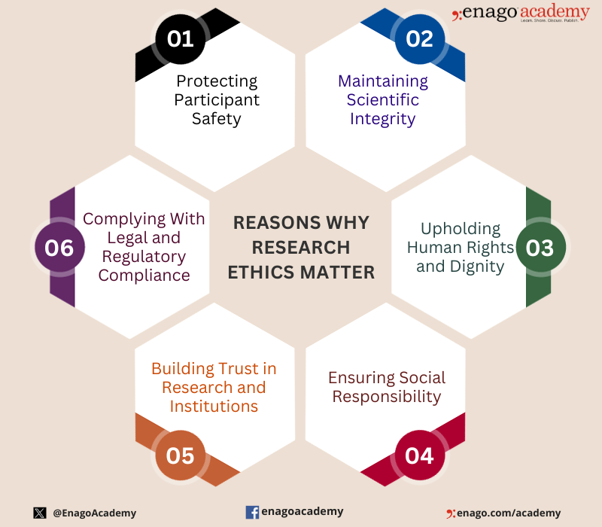
Reasons why research ethics matter
Protecting participant safety
Maintaining scientific integrity
Upholding human rights and dignity
Ensuring social responsibility
Building trust in research and institutions
Complying with legal and regulatory compliance
Graphic from Enago Academy
enago.com/academy